Lameness in Cows: Causes, Types, Stages and Early Detection
Lameness in cows is a sign of pain in the legs, most often in the hooves. It is easier to treat at an early stage, but these are exactly the cases that are usually missed during routine checks. We look at the causes and types of lameness, the locomotion scoring scale, when to call a vet, and how AI-powered cameras help spot the problem earlier.
Why lameness is a serious problem for a farm
Lameness is one of the most common problems in dairy herds. A review of 53 studies covering almost 415,000 cows from 3,945 herds found that on average 22.8% of cows were lame and 7% were severely lame. In some herds, the share of lame cows reached 88%.
What lameness costs a farm:
- Less milk. Walking to the feed bunk and standing at it hurts, so the cow eats less and loses milk yield and body condition.
- Poorer reproduction. In a study by Sprecher and colleagues, cows with a lameness score above 2 out of 5 took longer to be inseminated after calving and needed more inseminations per pregnancy.
- Culling. In the same study, these cows were 8.4 times more likely to leave the herd.
- Costs. Hoof trimming, treatment, vet visits and replacement of culled cows.
- Herd welfare. Lameness means constant pain for the animal.
Causes of lameness in cows
Lameness is not a disease in itself but a symptom. It is usually caused by several factors at once:
- Hoof diseases: sole ulcers, white line disease, digital dermatitis, interdigital phlegmon (foot rot).
- Housing: wet, dirty and slippery floors, hard or cramped stalls, long periods standing on concrete while waiting to be milked.
- Feeding: sudden diet changes and rumen acidosis after calving weaken the hoof horn. A lack of minerals and vitamins also affects its quality.
- Hoof care: irregular preventive hoof trimming.
- Injuries: slips, knocks and fights within the group.
Types of lameness
The causes of lameness fall into three groups. Treatment depends on the group, so the cause should be identified by a vet or a hoof trimmer.
- Non-infectious lesions of the hoof horn: sole ulcers, white line disease, sole hemorrhages, laminitis. The cow favors the leg, and horn damage is visible during trimming.
- Infectious hoof diseases: digital dermatitis (Mortellaro disease), interdigital phlegmon, heel erosion. Redness and ulcers are visible on the skin near the heels or between the claws, with swelling and sometimes a strong odor. Several cows in a group are often affected at once.
- Lesions above the hoof: injuries, bursitis and arthritis of the joints, muscle and ligament damage. Joint swelling is visible, and the cow is reluctant to get up and lie down.
Stages of lameness: the 1–5 scale
To make sure different people score lameness the same way, vets and herd managers use gait scoring scales. The most widely used is the five-point Sprecher scale, proposed in 1997. It focuses on back posture and the way the cow walks.
- 1 — normal. The back is flat when standing and walking; the gait is normal.
- 2 — mildly lame. The back is flat when standing but arches when walking; the gait is normal.
- 3 — moderately lame. The back is arched both standing and walking; strides are shortened.
- 4 — lame. The back is always arched; the cow walks carefully, one step at a time, favoring the leg.
- 5 — severely lame. The cow does not bear weight, or barely bears weight, on one or more legs.
Cows scoring 3–5 are usually considered lame, and those scoring 4–5 severely lame. The most important scores for a farm are 2 and 3: the cow does not look sick yet, and this is exactly the time to examine her.
Why lameness gets missed
At an early stage, only posture and stride length change. Cows hide pain, and staff see the herd in motion only in snatches, usually during milking, when there is no time for it. By eye, people mostly notice severely lame cows and miss moderate lameness.
The gap can be large. In a study of 205 dairy farms in England and Wales, an average of 36.8% of cows were lame, yet most farmers did not consider lameness a serious problem on their farm.
Late treatment is expensive. In another UK study, with the usual approach it took about two months from the moment a cow was first recorded as lame until she was treated. Cows treated within 48 hours of detection needed repeat treatment less often and had less severe hoof lesions, and four weeks later there were fewer lame cows in that group.
When to call the vet right away
- The cow does not bear weight on a leg.
- There is swelling, a wound or a strong odor above the hoof.
- Several cows in a group are lame at the same time.
- Animals have a fever, drooling, blisters or ulcers on the hooves, udder or in the mouth. These are also signs of dangerous infections, including foot-and-mouth disease. A suspected case of foot-and-mouth disease must be reported to the state veterinary service immediately.
How AI detects lameness from video
Computer vision systems do what a herd manager does when scoring gait, but every day and for every cow:
- A camera films the cows where they walk one at a time, for example at the exit of the milking parlor.
- The system identifies the cow: by ear tag, by chip or by appearance.
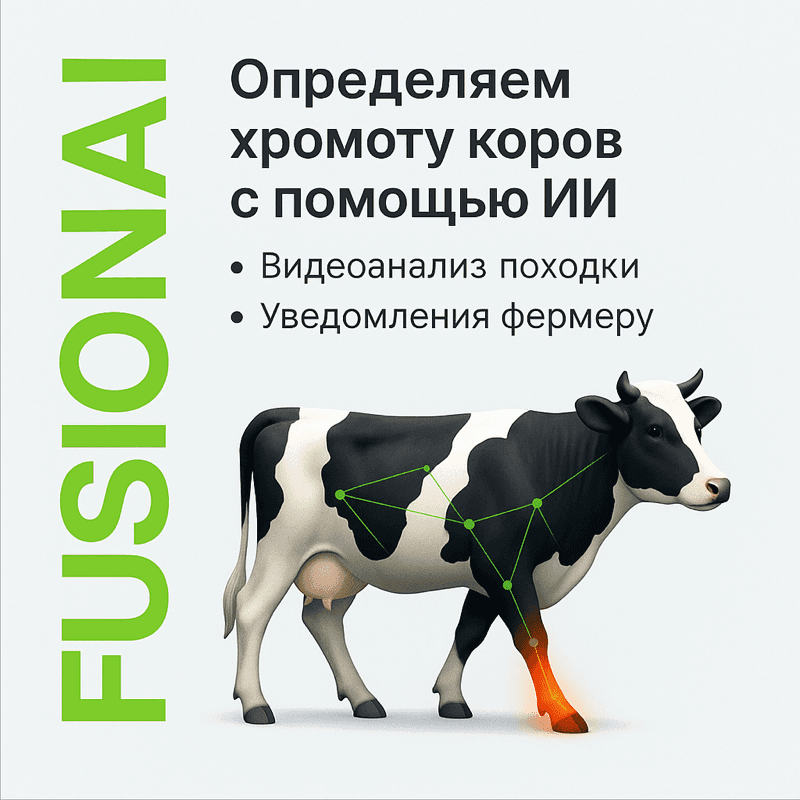
- A neural network finds key points of the body in the frame (back, head, leg joints) and tracks them from frame to frame.
- The movement of these points is used to calculate signs of lameness: stride length and speed, symmetry of weight bearing, back arch.
- The signs are combined into a risk score, and the farm receives a list of cows to examine.
Pedometers and collars work differently: they count steps and lying time, because a lame cow walks less and lies down longer. A camera assesses the gait itself, and the cow wears nothing.
How it works in FusionAI
The FusionAI early lameness detection system is a ready-to-deploy solution.
- Cameras are installed at the exit of the milking parlor.
- The system recognizes cows by appearance, with no ear tags, chips or collars. The identification module tells cows apart by head and coat pattern with 99.7% accuracy on the company's dataset.
- Algorithms assess stride speed and length, asymmetry of weight bearing, back arch and micro-pauses, and assign each cow a risk score.
- Staff receive a list of cows to examine. Notifications arrive in the web dashboard, in Telegram or by SMS.
- Video is processed on a server in the background. No dedicated maintenance staff are needed; the team installs updates remotely.
- The system suits both farms with 50–200 cows and complexes with 1,000 cows or more.
- A turnkey pilot is launched in 6–8 weeks. FusionAI currently monitors more than 5,000 head of cattle.
Frequently asked questions
Can AI detect lameness in a cow?
Yes. A computer vision system assesses the gait and posture of every cow from video and shows which cows have developed signs of lameness. It does not make a diagnosis: the cause is determined by a vet or hoof trimmer during an examination.
Do cows need sensors or a collar?
Not with FusionAI. The cameras are installed on the farm, and the system recognizes cows by their appearance.
Does the system replace the vet?
No. It saves time spent searching: instead of examining the whole herd, staff check the cows on the list.
How much does it cost?
The price is calculated individually and depends on herd size, number of farms and the modules chosen. FusionAI prepares a commercial proposal free of charge on request.
How long does it take to launch?
A turnkey pilot takes 6–8 weeks.
Want to test the system on your farm? Send us a request: we will discuss your farm's needs and prepare a pilot plan and a commercial proposal.
Related FusionAI solutions
If this topic is relevant for your farm, explore these solutions: